



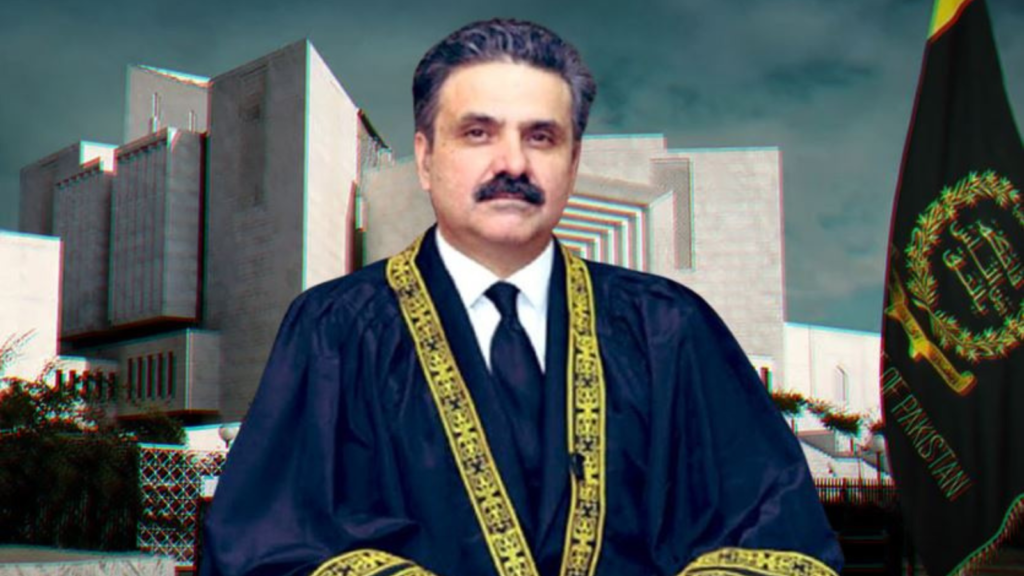
Justice Yahya Afridi is to take over the chief justice office of Pakistan on Saturday. It has come at the time when the amendment in the 26th constitutional article already abolished the seniority principle in the choice of a Chief Justice to his office. This has further split the legal profession into two poles, where each camp is flushing against standing loyalties.
A parliamentary committee, which had nominated the Chief Justice, selected the nominated names of Justice Yahya Afridi and forwarded it to Prime Minister Asif Ali Zardari for the formal notification of appointing Justice Afridi in the top slot of this country. The oath-taking ceremony at the President’s House will be attended by around 300 guests.
The retirement of Chief Justice Qazi Faez Isa, who himself sent a congratulatory message to the newly nominated Chief Justice, Justice Yahya Afridi, was followed by the appointment of Justice Afridi. Though the new Chief Justice has received congratulations from the legal community, its support is not uniform. Leading legal bodies have vented their sourness over the abolition of the principle of seniority that would otherwise have postmarked Justice Mansoor Ali Shah as the next Chief Justice.
Although some, such as the former Supreme Court Bar Association (SCBA) president Ahsan Bhoon, have welcomed Justice Afridi’s appointment, others, including Senator Hamid Khan himself, were of the view that Afridi would do better waiting for his turn rather than accepting that position in such a shabby manner. But perhaps more telling is Khan’s argument that the appointment of the third most senior judge as Chief Justice is to split the judiciary in this case, which assertion reflects much of what his opponents have in opposition to these new constitutional changes.
It is evident that there is dissent in the legal circles, as lawyers in Balochistan and the members of the Lahore High Court Bar Association have demanded that Afridi decline the appointment. Actually, they emphasize that only Justice Mansoor Ali Shah, the senior-most judge of the Lahore High Court and said to be the senior-most among the four names proposed by the President, should be accepted as the next Chief Justice.
Despite all the commotion, some quarters of legal bodies, especially Karachi and Sindh, have welcomed the appointment of Afridi. They look forward to him repairing the reputational damage they say the judiciary incurred during the period of outgoing Chief Justice Qazi Faez Isa.
Only the coming days will tell how this two-pronged response from the judicial fraternity molds the future of Pakistan’s judiciary and whether the big voices of senior lawyers, such as the leader of the legal team in Musharraf’s trial, Hamid Khan, succeed in launching anti-amendment movements. Does Justice Afridi manage to bring the entire bar together, or does continuous resistance await him?.
Read More News here: https://behindthecurtain.blog/justice-mansoor-ali-shah-refuses-to-join-special-bench/